
Jiting Liu刘纪霆

Third-year undergraduate in Mathematics · Embodied AI

I am currently a research intern in Prof. Li Yuan's group at Peking University Shenzhen Graduate School, and am mentored by Dr. Kai Wang at the National University of Singapore (NUS). Previously, I was a research assistant at the MINT Lab at SJTU and in Prof. Taku Komura's group at HKU.

My research interests lie in embodied AI, particularly how a single robot policy can keep extending to new tasks and embodiments. In MorphAct, we found that different manipulation skills pull shared parameters in conflicting directions, so we let the policy generate parameters for its perception and action modules from the current context. In Evo-Depth (NeurIPS 2026), we extract implicit depth from RGB to give a VLA better spatial perception. At HKU, I worked on cross-embodiment action retargeting, turning human–object interactions into executable motions for dexterous hands and robot arms.

liujiting616@gmail.comCVGoogle ScholarGitHubSemantic Scholar

Jiting Liu

I am applying for research master's and PhD programs starting in 2028. Feel free to get in touch.

News

Publications

* Equal contributionFull list on Google Scholar

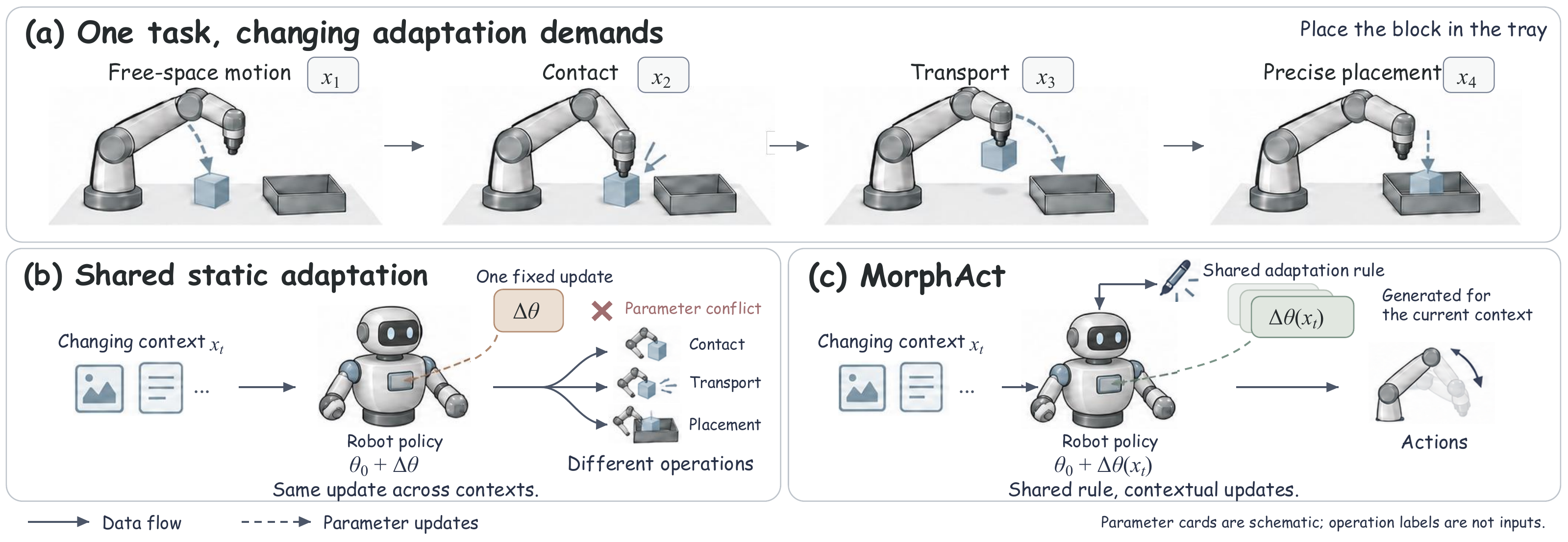
MorphAct teaser: the policy generates parameters for its perception and action modules from the interaction context.

MorphAct: Robot Policies Morphing with the Worlds They Act In

Ziyan Liu*, Jiting Liu*, Weihong Zhong*, Wenda Yu, Yeqiu Chen, Jason Li, Xiaojiang Peng, Shuyuan Hu, Kai Wang, Bo Zhao

ICLR 2027 (under review)

On 65 RoboCasa365 atomic tasks, each parameter update raises the loss of 22–46 other tasks. MorphAct uses two coupled generators that produce low-rank updates for the VLM and the action module from the current observation, instruction and robot state.

My part: Built the parameter-generation module and ported it to X-VLA, π0 and π0.5: Meta-World success rises by 7.57, 16.30 and 15.72 points.
arXivCode★ 42Project page

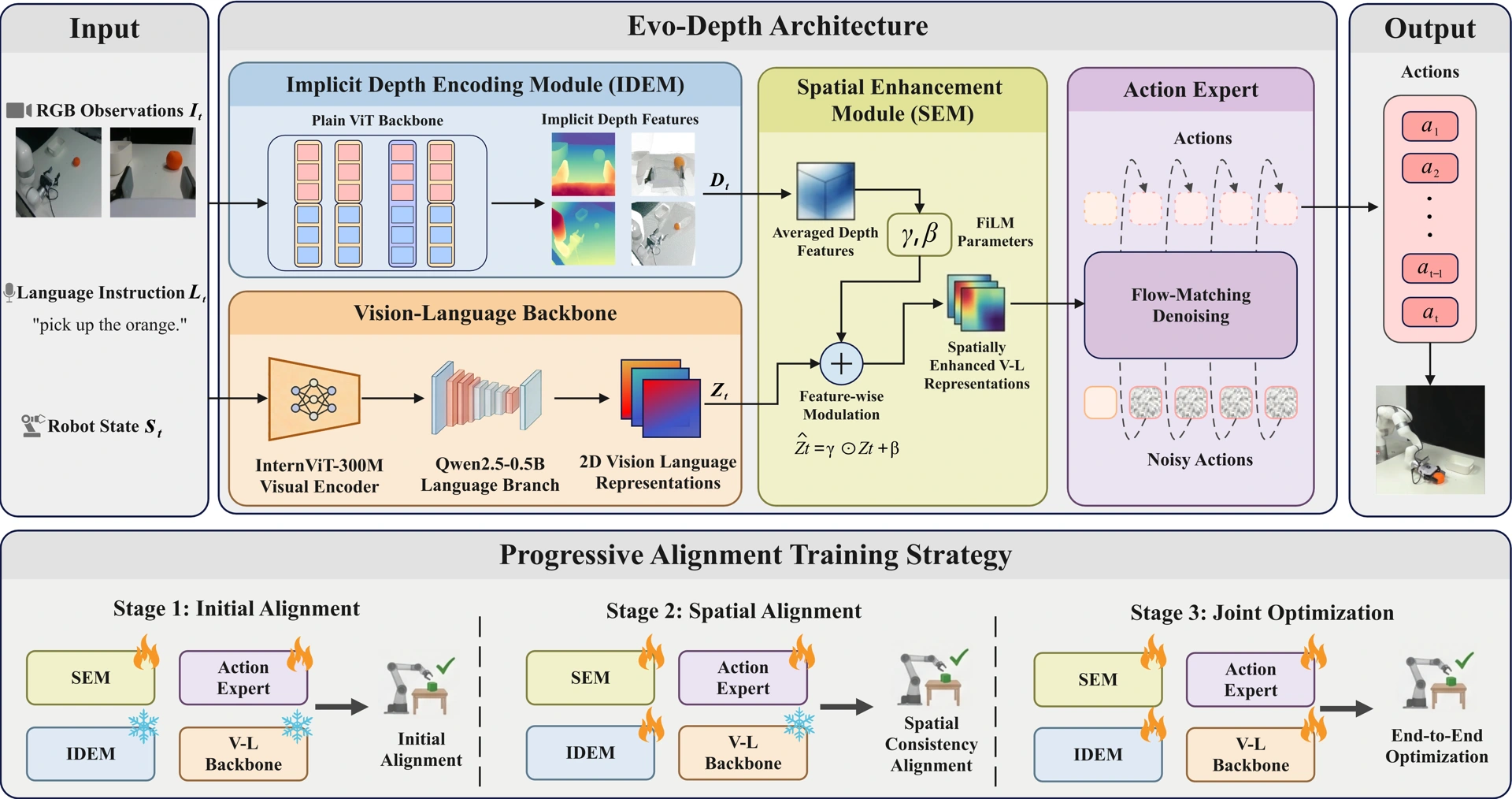
Evo-Depth architecture: implicit depth encoding, spatial enhancement and action prediction.

Evo-Depth: A Lightweight Depth-Enhanced Vision-Language-Action Model

Tao Lin*, Yuxin Du*, Jiting Liu*, Nuobei Zhu, Yunhe Li, Yuqian Fu, Yinxinyu Chen, Hongyi Cai, Zewei Ye, Bing Cheng, Kai Ye, Yiran Mao, Yilei Zhong, MingKang Dong, Junchi Yan, Gen Li, Bo Zhao

NeurIPS 2026

No depth camera needed: implicit depth features from RGB are injected into the vision-language representation with FiLM. Meta-World 84.4% (Evo-1: 80.6%), LIBERO 95.4%, LIBERO-Plus 69.6% (π0-FAST: 53.6%).

My part: Proposed the FiLM-style depth injection; led the model design, implementation and main experiments.

arXivCode★ 74

Other contributions

Experience

  1. Nov 2026 – PresentCurrent

    Peking University Shenzhen Graduate School

    Research Intern · Prof. Li Yuan's group

  2. 2026 – PresentCurrent

    National University of Singapore (NUS)

    Remote research

    Mentor: Dr. Kai Wang

    Parameter generation for robot policies (MorphAct, co-first author).

  3. Summer 2026 – Oct 2026

    The University of Hong Kong

    Research Assistant · Miro Dynamics–HKU CGVU Joint Lab · Prof. Taku Komura's group

    Cross-embodiment action retargeting: turning human–object interactions into executable motions and training data for dexterous hands and robot arms.

  4. 2025 – 2026

    Shanghai Jiao Tong University

    Research Assistant · MINT Lab · Prof. Bo Zhao's group

    Evo-Depth (co-first, NeurIPS 2026) and MorphAct (co-first); contributed to Evo-0, Evo-1 (CVPR 2026), Focusable Monocular Depth Estimation (NeurIPS 2026) and LA4VLA.

Education

Sichuan Agricultural University

B.S. in Mathematics · Rank 7 / 183

2024 – 2028 (expected)